
Follow us:


EXHIBITION
GALLERY
ÍNTIMO - PROJECT SPACE
OUR PERMANENCE
Asociación Femenina para el Desarrollo de Sacatepéquez (AFEDES), Heidy Cabrera, Silvia Etec
28 FEB - 24 MAY, 2026
February 28 – May 24, 2026
Opening: Saturday, February 28, 11 a.m.to 4 p.m.
Curated by Ketzali Awalb’iitz Pérez Pérez
Curatorial assistance by B’alam García
Artists:
Asociación Femenina para el Desarrollo de Sacatepéquez (AFEDES)
Heidy Cabrera
Silvia Etec
The artistic work of Maya women today is the result of an insistence on not disappearing, as individuals and as a collective: a daily act that allows us to transcend within our family histories, our communities, and as nations. Our Permanence is an exhibition conceived as a space for aesthetic, political, and community-based reflection on the place of Maya women in the history and the contemporaneity of art.
In contrast to traditional art history taught within Eurocentric frameworks that have folklorized our history and knowledge, this exhibition proposes bringing the creation and thinking of Maya women artists into an intimate setting through ÍNTIMO, La Nueva Fábrica’s exhibition program, which enables closer, warmer dialogue and interaction with the public. Here, artistic practices are not static objects nor isolated aesthetic elements; rather, art transcends as an active verb, ensuring survival, continuity, and memory. It is the affirmation of our permanence in the face of invasion, genocide, and policies of assimilation.
The exhibition brings together two contemporary Maya artists: Heidy Cabrera, working through photography (Mam Maya from San Juan Ostuncalco, Quetzaltenango), and Silvia Etec, working through pottery and sound research (Kaqchikel Maya from Chimaltenango), as well as the Kaqchikel Maya women’s organization AFEDES (Asociación Femenina para el Desarrollo de Sacatepéquez), through textile work and their struggle for the recognition of collective intellectual property.
Each of them shares work centered on the active verb of permanence: a continuity that weaves personal, family, and collective histories, brought together through three elements—fire, community, and memory.
The Artworks
The exhibition presents a series of new installations alongside preexisting works. The public is welcomed by the installation Guardianes del Itza’ (2025) by artist-researcher Silvia Etec. Frogs have been historically depicted on ancient vessels, lintels, and Maya codices, and to this day, under Silvia’s gaze, they are the millenary bearers of life and the origin of Lake Itza’. The artist presents twelve indirect-blown wind instruments with an air channel, made from clay from Rabinal, burnished with agate stone, and sealed with beeswax. Eleven works take the form of frogs, and one hydraulically driven instrument takes the form of a tadpole; together they make up Guardianes del Itza’. All the works complete their preparatory journey in fire, which compacts not only the materials but also the artist’s intentions, in a custom-made, ephemeral kiln. This installation is inspired by a visit to Lake Petén Itza’, specifically during a stay in the village of El Remate. It is an approach to the ancestral relationship between frogs and the Maya worldview.
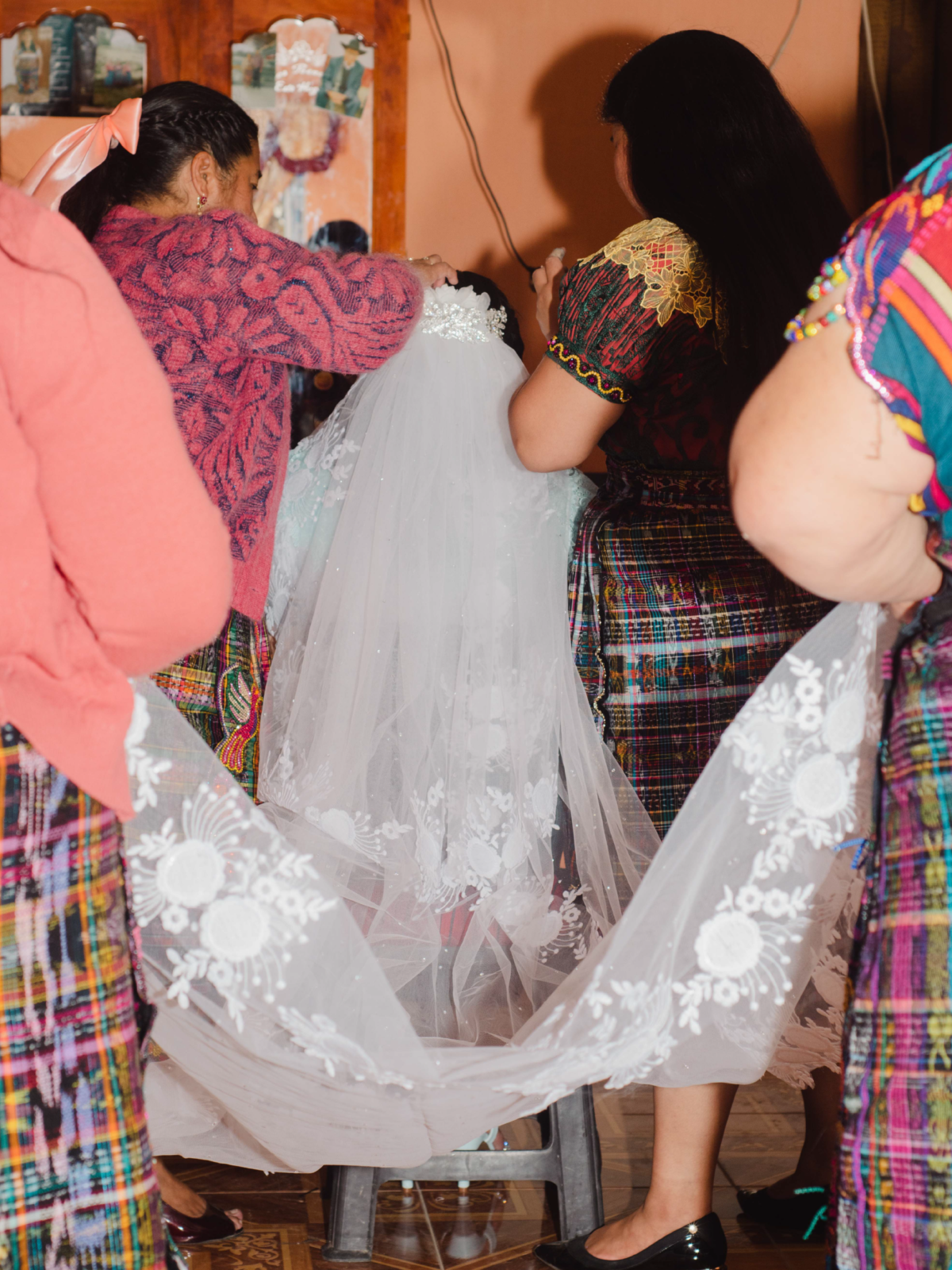
Following this is the installation by photographer Heidy Cabrera, which presents an intimate and personal photographic documentation of how her family builds its own memory through celebrations, cooking, and fire. In this timeless record, we see the women of her family and how they sustain the survival of family memory. This installation proposes a deep dialogue around how women build a legacy in the kitchen through fire. From a Western perspective, the kitchen is often perceived as a space of oppression for women; however, through the lens of an Indigenous community, it is a space that safeguards stories, recipes, and life.
The exhibition is complemented by the collective vision of AFEDES, whose transgenerational work opens up other ways of interpreting textiles and of demanding political and historical recognition of collective memory as weavers. This installation presents a photographic archive of their work, shaped by an ongoing search to narrate themselves through textiles. A large-scale tocoyal and an aerial piece that interprets the tassels of the sashes from the municipality of Sumpango, Sacatepéquez, reimagine the uses of Maya dress. These works reveal a collective and community-based effort to ensure the permanence of the history they have inherited and that they also wish to pass on as an inheritance.
Ketzali Awalb’iitz Pérez Pérez
Asociación Femenina para el Desarrollo de Sacatepéquez (AFEDES) is a collective of Indigenous Maya women organized to promote Utz’ K’aslemal (life in fullness) through reflection, political education, and the recovery of ancestral knowledge. Founded in 1988 in Sacatepéquez, Guatemala, it emerged to confront malnutrition and the exclusion of women, and over time deepened its struggle against patriarchy, racism, colonialism, and capitalism affecting their communities. AFEDES works for autonomy, equal opportunities, the defense of territories, and Maya cultural practices—such as food production, weaving, and traditional medicine—promoting alternative, violence-free ways of life. It is part of the National Movement of Women Weavers.
Heidy Lucas Cabrera (1992) is a Mam Maya woman, graphic designer, documentary photographer, cultural organizer, and mother. She was born in San Juan Ostuncalco, with roots and community ties in Huitán, Quetzaltenango. She began her path in photography in 2015, convinced of the power of the image as a tool for memory, denunciation, and resistance. Her work focuses on documenting the experiences, struggles, and artistic expressions of Maya girls and women from their own contexts, rejecting folklorization. She has participated in national and international exhibitions and actively collaborates with organizations and movements that promote art, rights, and the autonomy of Indigenous peoples.
Silvia Carolina Etec Muxtay (1995) is a Kaqchikel Maya musician, composer, and artist-researcher from Chimaltenango, Guatemala. Her practice focuses on the construction of Maya musical instruments in clay, exploring the relationship between ancestral memory, sonic experimentation, and contemporary creation. Since 2016 she has developed research processes that bring together ancestral and contemporary technologies. She holds a degree in Music Education from Universidad Da Vinci de Guatemala and has participated in collective exhibitions in various spaces across the country. She currently leads the project Alfarera Colibrí, a platform through which she researches, creates, and shares pedagogical methodologies related to clay, sound, and spirituality.