


EXHIBITION — GALLERY
El canto de la fábrica
Tania Candiani
Opening: Saturday, October 10, 11:00 – 4:00 P.M.
Textiles are inseparable from histories of knowledge, labor, and communal life. They carry memory across generations while remaining bound to changing systems of production. In their making, bodies, materials, and technologies enter into relation, while knowledge is transmitted, adapted, and transformed. El canto de la fábrica (The Song of the Factory) begins within this dense field, approaching textile production not through the finished object, but through the communal forms of knowledge that make its existence possible.
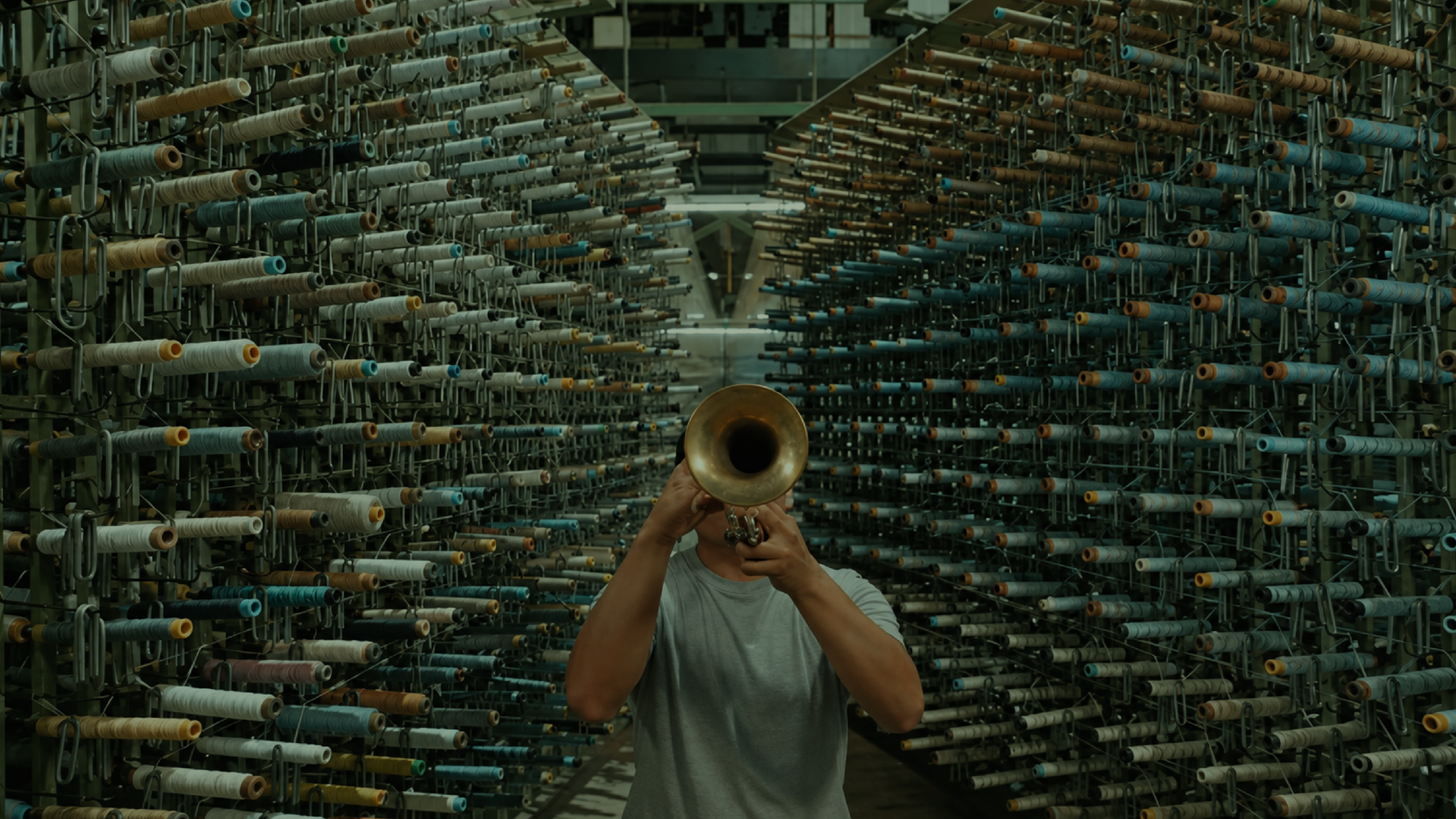
Tania Candiani developed the project through an immersion in the textile factory neighboring La Nueva Fábrica, whose history is deeply intertwined with the institution’s origins. Through sustained listening and collaboration with its workers, she attended to the rhythms, gestures, and sounds that shape everyday life in the factory. What emerges is not a portrait of industrial production, but an encounter with knowledge in motion: embodied through practice, accumulated over time, and continuously renewed.
The newly commissioned project extends a longstanding trajectory in Candiani’s work, from industrial archaeology to the embodied traces of textile labor and its transmission across generations. La Nueva Fábrica itself stems from a genealogy rooted in textile production, still inscribed in its name. The knowledge and relationships from which the art center emerged enter the exhibition space not as a closed past, but as a living presence that continues to unfold alongside it. In Guatemala, histories of labor are marked by inequality and struggle, but also by collective organization and the transmission of knowledge through work. Candiani shifts attention from what labor produces toward what labor knows, approaching the factory as a place where expertise resides in bodies and relationships. To bring such knowledge to the foreground is also to ask what forms of knowing are granted visibility, and whose labor can be recognized as cultural memory.
The video installation El canto de la fábrica emerges from a collaboration with factory workers who are also musicians. Their knowledge of the machines has been forged through the intimacy of daily work, while music offers another language through which to hear and transform that familiarity. In a collective act of listening, mechanical rhythms are answered and echoed through voice and instrument. An orchestra takes shape: a collective anatomy of human and mechanical bodies, each carrying its own tempo. A second video installation, Sala de terminados, turns toward a women-only workspace and another form of collective rhythm. Gestures repeated over time become choreography; voices and bodies form a choir sustained by familiarity, responsiveness, and mutual attention.
Communal knowledge is the pulse of El canto de la fábrica. To bring it into the exhibition space is not to transform labor into art, but to make perceptible a relation that has always been there: to honor the workers and the knowledge held in their art as part of the living roots from which La Nueva Fábrica continues to grow.
Download the press release here.
Tania Candiani (Mexico City, 1974) cultivates an artistic practice centered on translation as both method and politics to shed light on how knowledge moves between bodies and technologies and what becomes perceptible through acts of deep listening. Her projects often emerge from sustained engagement with specific sites and communities, where collaboration makes visible forms of intelligence embedded in inherited or communal practice. Tania Candiani represented Mexico at the 56th Venice Biennale. She has created commissioned projects for international biennials including the 15th Shanghai Biennale (2025), Helsinki Biennial (2025), 24th Paiz Art Biennial (2025, Guatemala), PAAD/Public Art Abu Dhabi Biennial (2024), XI Lanzarote Biennial (2023), 23rd Biennale of Sydney (2022), 15th Cuenca Biennial (2021), XIII Havana Biennial (2019), 4th Kochi-Muziris Biennale (2018), 11th Cuenca Biennial (2011), among others. She is a Guggenheim Fellow and a former Smithsonian Artist Research Fellow.